Prepared by the Imperial Cushions editorial team. Laboratory terminology is retained where a report is cited; historical context and dealer judgment are identified as interpretation.
A laboratory report is the factual starting point for evaluating an antique diamond. It can identify the stone, record measurements and describe important grading characteristics. It cannot tell you whether the diamond has a compelling outline, a lively facet pattern or the visual character that makes one old cut more desirable than another.
This guide explains how to read the report without asking it to answer questions it was not designed to answer. The discussion applies to natural old mine cuts, antique cushions and related historic cutting styles. It should be used together with an in-person or high-quality video inspection.
Begin by confirming the report and the diamond
Record the laboratory, report number and report date. Use the laboratory’s own report-check service when one is available. If the report mentions a laser inscription, verify its location and text under magnification. An inscription is useful evidence of identity, but it is not a substitute for matching the diamond’s measurements and identifying characteristics to the report.
Older reports may predate a repolish, recut or damage event. When the measurements or clarity characteristics do not match, pause the evaluation and ask for an updated laboratory assessment.
Read the measurements before the carat weight
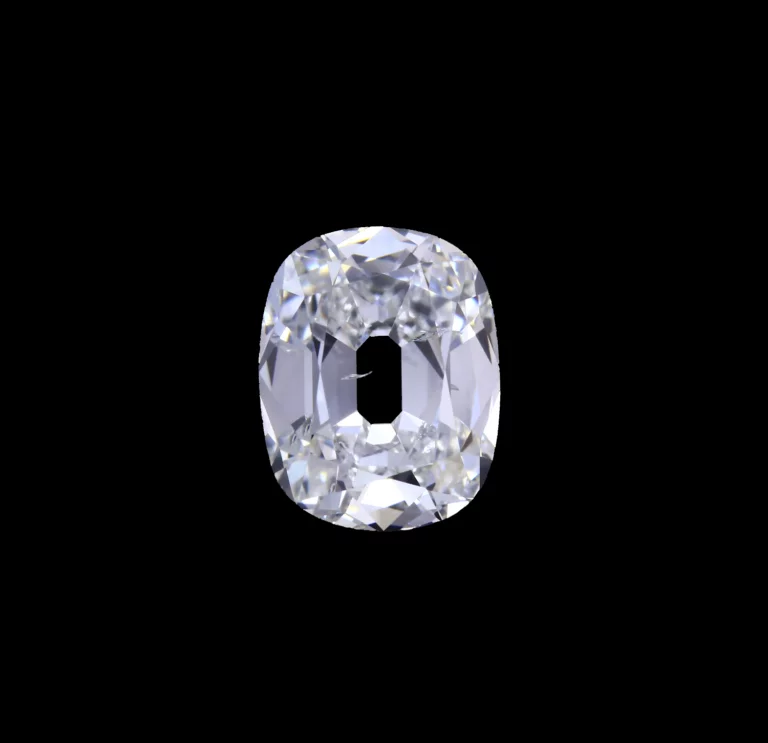
Carat is weight, not face-up size. Two antique cushions of equal weight can present very differently because their outlines, depths and girdles differ. Reports normally list length, width and total depth in millimeters. Divide length by width to calculate the length-to-width ratio.
- A ratio close to 1.00 indicates a squarer outline.
- A higher ratio indicates a more elongated outline.
- The number alone does not describe the corners, shoulders or symmetry of the silhouette.
Compare millimeter spread with the diamond’s weight, but avoid applying modern round-brilliant targets to a hand-shaped antique cushion. Some depth may support a distinctive crown, pavilion pattern or protected girdle. Excessive hidden weight, however, can reduce face-up presence.
Shape and cutting style need visual confirmation
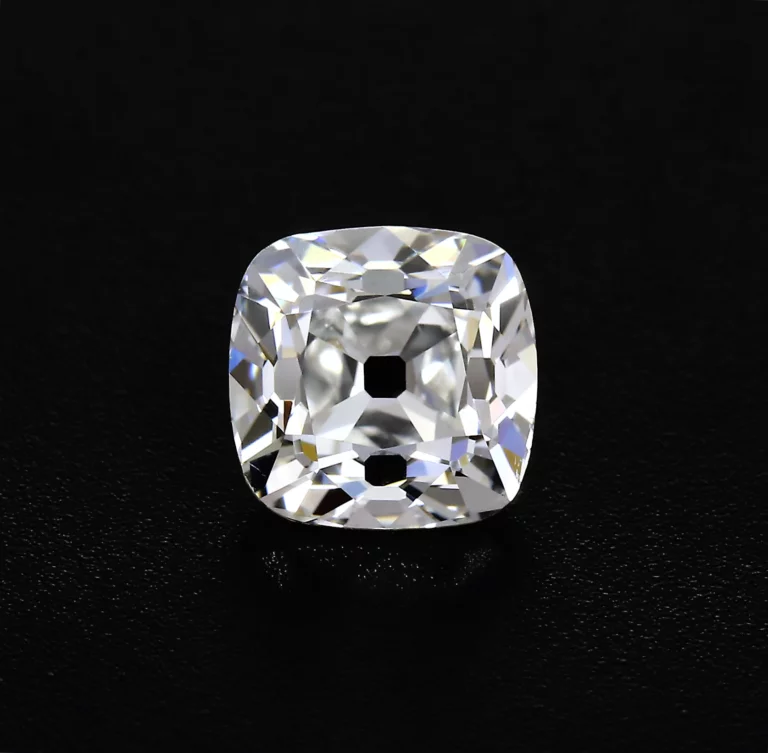
A grading report may use a broad shape or cutting-style description. Historic stones do not always fit neatly into modern labels. “Cushion modified brilliant,” “old mine brilliant” and similar terms can include diamonds with noticeably different facet structures.
Use the report wording as a classification, then inspect the actual facet pattern. Look for the relationship between the central facets, pavilion mains, crown facets and culet. Observe the stone while it moves through diffuse daylight, spot lighting and mixed lighting. A still photograph cannot show the complete pattern of brightness, contrast and fire.
Color is graded under controlled conditions
Laboratories grade color using standardized viewing conditions and comparison stones. The grade gives a common reference point. Face-up appearance can still vary with facet pattern, fluorescence, surrounding metal, lighting and the observer.
Antique cuts may concentrate or disperse visible body color differently from modern cuts. Assess the stone face-up and from the side. If the diamond will be mounted, consider how yellow gold, platinum or another metal may influence perception. Do not assume a higher letter grade automatically produces the more attractive antique diamond.
Clarity requires location and context
The clarity grade summarizes the visibility and significance of internal and external characteristics at the laboratory. The plot or comments can help identify the type and general location of inclusions, but the grade alone does not answer every durability or appearance question.
For an antique stone, ask:
- Is an inclusion visible face-up without magnification?
- Does it sit near a corner, point or thin section of girdle?
- Is a surface-reaching feature protected by the intended setting?
- Are chips, cavities, naturals or extra facets noted?
- Could an old mounting have obscured a condition issue when the report was issued?
Clarity characteristics can also be useful identifiers. Their position relative to the outline and facets helps confirm that the inspected diamond is the reported diamond.
Fluorescence is a description, not a verdict
The fluorescence entry describes the strength and usually the color of the diamond’s reaction to long-wave ultraviolet radiation. It does not by itself establish that a diamond is more or less beautiful. Most viewing environments contain varying amounts of ultraviolet energy, so inspect the actual stone in multiple lighting conditions.
Check for transparency or haziness in ordinary light rather than inferring it from the fluorescence label. Also distinguish fluorescence from phosphorescence, which is an afterglow that may continue briefly after the ultraviolet source is removed.
Comments can contain important qualifications
Read every comment. Reports may note additional clouds, surface graining, internal graining, inscription details, treatments or limits of the plotted diagram. A comment can be more relevant to practical evaluation than a prominent grade printed elsewhere on the report.
If a diamond is represented as untreated and of natural color, the appropriate laboratory documentation should support those statements. Fancy-color reports require careful reading because color origin, distribution and description materially affect how the stone is understood.
What a grading report does not prove
A standard grading report does not normally prove a geographic mine source, a historic owner, a cutting date or a relationship to a famous collection. Type IIa classification describes very low measurable nitrogen in the crystal lattice. It is not proof that a diamond came from the historic Golconda mines.
Provenance requires a separate chain of evidence, which may include dated invoices, archival records, signed jewel documentation, photographs and traceable ownership history. Treat unsupported stories as stories, not as laboratory conclusions.
A practical report-to-stone inspection sequence
- Verify the report number through the issuing laboratory.
- Match the measurements, inscription and clarity characteristics.
- Calculate the length-to-width ratio and assess face-up spread.
- Inspect the outline, corners, girdle and culet under magnification.
- Observe brightness, contrast and fire while the stone moves.
- Compare appearance in diffuse, spot and mixed lighting.
- Review every report comment and ask for clarification where needed.
- Consider the intended setting and any vulnerable areas.
The report establishes a shared technical language. The final decision still depends on the diamond itself. Browse the current diamond dossiers, use the Antique Cushion Diamond Atlas, or arrange a documented inspection through Inspection and Service.
Reference: GIA diamond grading services. Laboratory terminology and report formats can change, so verify the current report directly with its issuer.