Prepared by the Imperial Cushions editorial team. Laboratory terminology is retained where a report is cited; historical context and dealer judgment are identified as interpretation.
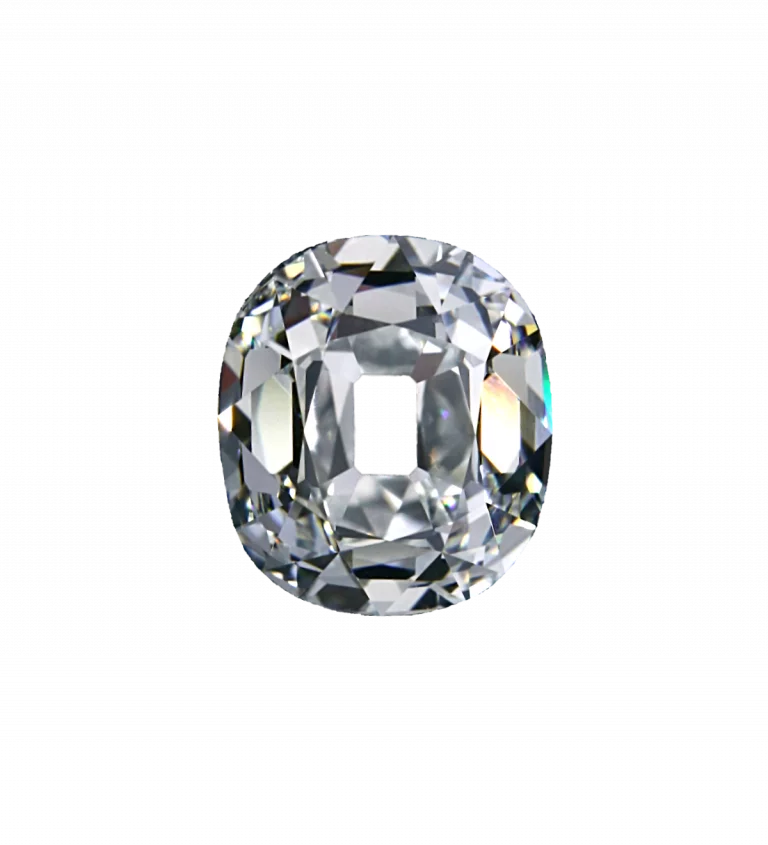
Old mine cushions are not best understood through a single ideal-proportion chart. Their appeal comes from the relationship between outline, crown, pavilion, table, culet and facet pattern. Measurements are essential, but they describe the architecture rather than issuing a verdict.
This guide provides a disciplined way to use proportion data while respecting the individuality of hand-shaped antique diamonds.
Start with the outline
Before calculating percentages, study the silhouette. Old mine cushions may be nearly square, softly rectangular, distinctly elongated or irregular in a way that gives the diamond a recognizable identity. Look at the balance of corners, shoulders and sides. A stone can be technically asymmetrical while still feeling visually composed.
Calculate length-to-width ratio by dividing the length by the width. The result is a useful label for comparison, not a complete description. Two diamonds with the same ratio can have very different corners and side profiles.
Face-up dimensions and weight distribution
Carat measures weight. Face-up dimensions describe visible spread. A deeper stone may show less area for its weight, but that depth may also support a high crown or pavilion architecture that produces the desired light pattern.
Compare old mine cushions with other old mine cushions of related outline and weight. Modern round-brilliant spread expectations are not a suitable universal benchmark. The correct comparison asks whether the diamond’s weight is used coherently and whether the face-up presence suits the buyer’s priorities.
Table size and the view into the stone
The table is the large central facet on the crown. A smaller table can accompany a higher crown and broad crown facets. A larger table can open the central view and change the balance between white brightness and colored fire.
The table percentage alone does not identify an attractive antique cut. Its visual effect depends on crown angle, pavilion arrangement, culet size and the surrounding facet pattern. Inspect the table area while the stone moves. Look for a balanced sequence of brightness and contrast rather than a permanently dark or glassy center.
Total depth and hidden weight
Total depth is normally expressed as a percentage of width. It combines crown height, girdle thickness and pavilion depth. A high number can indicate hidden weight, but a percentage should not be judged without the profile and face-up result.
Ask three questions:
- Does the diamond have sufficient face-up presence for its carat weight?
- Does the profile support an attractive crown and pavilion relationship?
- Does the diamond remain lively through normal viewing angles?
A shallow diamond can also have problems, including a weak center or reduced contrast structure. Proportion assessment is therefore a question of balance, not simply minimizing depth.
Crown height and fire
Many admired antique cushions have visibly developed crowns. Crown facets help disperse light into spectral colors. A high crown does not guarantee strong fire, but it is part of the optical system.
Observe the diamond in lighting that can reveal dispersion, such as small point sources, and in diffuse lighting that shows overall brightness and contrast. A stone that performs only under jewelry-store spotlights may feel less engaging in ordinary environments.
Pavilion structure and central pattern
The pavilion directs light back toward the viewer. In an old mine cushion, broader pavilion facets can create large, slower flashes. Variations in facet alignment can produce a distinctive central pattern. Some observers prefer a clearly organized pattern; others value a more irregular, animated appearance.
Check for excessive obstruction, where the observer or camera creates a persistently dark area. Some contrast is necessary to define the pattern. The question is whether darkness alternates dynamically with brightness as the stone, light or viewer moves.
Culet size and placement
The culet is a facet at the bottom of the pavilion. Viewed through the table, an open culet can appear as a small geometric feature. Its size contributes to the old-cut appearance and can influence the central pattern.
Assess whether the culet feels integrated, distracting or noticeably off-center. Slight displacement can be consistent with hand cutting. A large or strongly displaced culet may dominate the view. Inspect the culet for chips and ensure the proposed setting provides adequate clearance beneath it.
Girdle variation
Old mine cushions often have girdles that vary around the outline. Some variation may be original and visually harmless. Extremely thin areas can be vulnerable, while very thick areas can retain weight that is not visible face-up.
Map the girdle around the full circumference rather than relying only on a summarized report description. Corners and shoulders deserve particular attention because they influence both outline and setting design.
Symmetry, regularity and character
Modern symmetry grades are useful information, but antique appeal is not identical to geometric regularity. A hand-cut stone may have unequal corners or facet junctions and still present a compelling, balanced face-up image.
Separate harmless irregularity from distracting imbalance. Rotate the diamond slowly, view it from normal distance and then under magnification. If the eye repeatedly returns to one awkward corner or dead region, the asymmetry may be visually material.
A proportion worksheet for comparisons
For each candidate, record:
- Carat weight and millimeter dimensions.
- Length-to-width ratio.
- Table and total-depth percentages.
- Crown profile and pavilion impression.
- Culet size, placement and condition.
- Girdle thickness by location.
- Face-up brightness, contrast and fire in at least three lighting environments.
- Any persistent dark or weak areas.
- Outline observations and setting implications.
Use the worksheet to make precise comparisons, then return to the complete visual impression. The most appealing old mine cushion is rarely selected by optimizing one number in isolation.
Compare actual examples in the Antique Cushion Diamond Atlas, review how specialists judge diamond character, or browse the current diamond collection.