Prepared by the Imperial Cushions editorial team. Laboratory terminology is retained where a report is cited; historical context and dealer judgment are identified as interpretation.
Old mine cuts and modern cushion brilliants share a softly squared family of outlines. Their facet arrangements give you a much wider choice of appearance than the shape name suggests.
Follow the central pattern
Old mine cuts commonly have a visible culet, small table and broad facets. Modern cushion brilliants use several pavilion arrangements; GIA describes four- and eight-main versions and modified patterns with additional facets. Compare the size of the reflections and how much activity appears near the centre and edges.
Start with the 3.01 ct old mine cushion, then view the 7.51 ct cushion brilliant. Their photographs show different facet spacing and outlines. The size difference makes equally scaled images especially useful.
Choose through comparison
Watch each stone under the same light, at the same distance and through a slow rotation. Decide whether you prefer large, distinct flashes or a more closely packed pattern. Check condition and setting requirements before committing.
GIA’s cushion-cut guide explains the main facet arrangements. Our light-return article shows how to read them in motion.
See the details in a stone
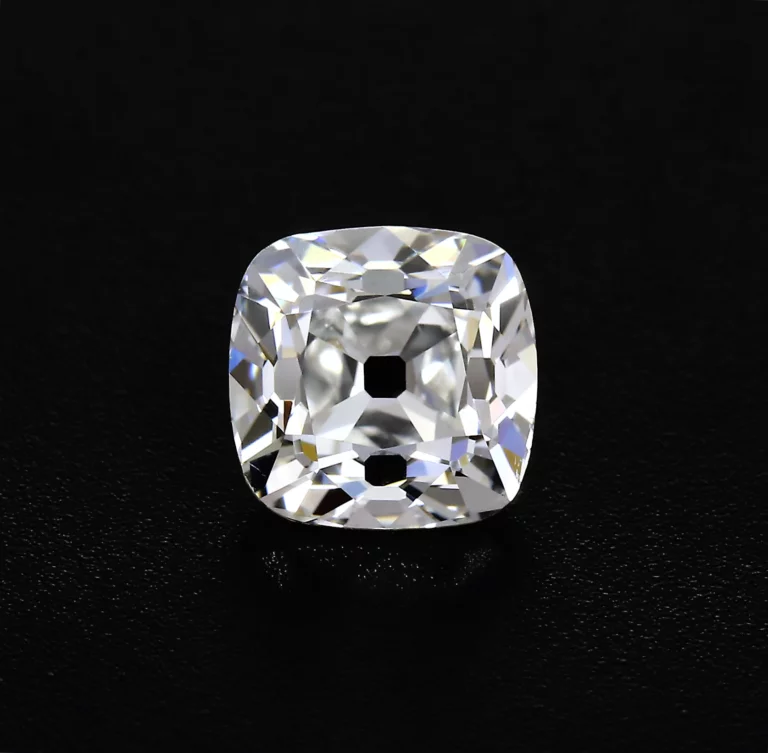
3.01 Ct. G VS2 Old Mine Cushion Brilliant
A near-square, 3.01 ct old mine cushion with a 51% table.
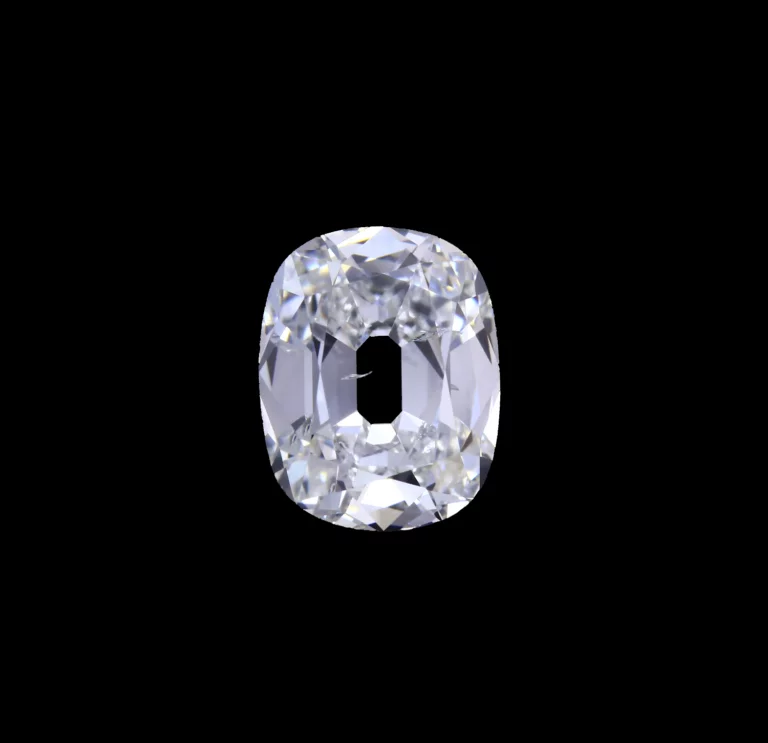
3.09 Ct. F SI2 Old Mine Cushion Brilliant
A 3.09 ct old mine cushion with a longer outline and 55.2% depth.